
InSituChem ®
Innovation in Immunohistochemistry
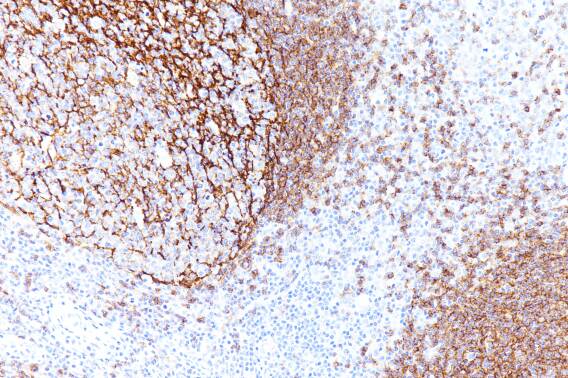
Human tonsil stained with anti-CD21 antibody.
Rabbit monoclonal antibody against CD21
Human complement receptor (CR)3 type 2 (CR2/CD21) is a multifunctional receptor for three well-described classes of ligands, belonging to complement activation regulatory protein family. The human CD21 gene lies in close vicinity on chromosome 1q. The human CD21 protein consists of 15 to 16 short consensus repeats, a transmembrane domain, and a short intracytoplasmic tail, is mainly expressed on mature B cells and follicular dendritic cells. In addition to interacting with the complement component C3d, CD21 binds CD237, IFN-a and Epstein-Barr virus on human B-cells and T-cells. CR2 has been primarily viewed as a B cell coreceptor and it participates in B lymphocytes activation, whose, biologic role is to amplify Ag receptor-mediated signal transduction.
Product identification
Catalogue number: ISC027
Packing size
- Ready to Use: 3mL (RTU), 7mL (RTU)
- Concentrated: 0.5mL (conc.), 1mL (conc.)
Principle of the procedure
The stated primary antibody is suitable for immunohistochemical staining of FFPE tissue sections based on specific antigen-antibody reaction. Using a detection system linked to HRP or alkaline phosphatase the antigen visualization is performed via specific binding of the primary antibody. Secondary antibody is binding to the primary antibody, and the enzyme complex labels this complex. The enzymatic activation of the chromogen results in a visible reaction product at the antigen site. Each step is incubated for a precise time and temperature and requires interposed washing steps. The specimen may then be counterstained. Results are interpreted using a light microscope.
Product specification
Primary antibody: CD21
Host: Rabbit
Subclass: IgG
Clone: ISR017
Species Cross-reactivity: Human; Others not known
Applications: Immunohistochemistry
Epitope Retrieval: Heat-induced epitope retrieval
Ready-to-use antibody: Prediluted antibody in antibody diluent buffer
Product label shows the specific lot number.
Prediluted antibody is ready-to-use and optimized for staining. No further dilution, reconstitution, mixing, or titration is needed.
Materials required but not provided
The following materials may be required for staining but are not provided with the primary antibody.
- Positive and negative controls
- Microscope slides (positively charged) and cover slips
- Water bath
- Humidified chamber
- Staining jars
- Stopwatch
- Xylene or xylene substitute
- Ethanol
- Deionized or distilled water
- Antigen retrieval reagent, e.g. Antigen Retrieval Buffers, Cat. No. D004, D007 and D008.
- Detection system, e.g. IHC Complete Detection system (Goat anti mouse/rabbit HRP, DAB staining), Cat. No. D007
- Wash buffer: e.g. IHC Wash Buffers, Cat. No. D003 and D010.
- Tap water/bluing reagent (e.g. ammonia water)
- Light microscope
Storage and handling
Store at 2 - 8 °C.
When stored correctly antibody is stable to the expiration date indicated on the vial. Do not use after expiration date. To ensure proper reagent delivery and stability of the antibody, replace the dispenser cap after every use and immediately place the bottle cool in an upright position.
Staining procedure
1. Cut 3-4 μm section of formalin-fixed paraffin-embedded (FFPE) tissue and place on positively charged slides.
2. Dry at 65°C for 1-2 hours.
3. Deparaffinize and rehydrate, using xylene and graded ethanol, distilled/deionized water.
4. Heat-induced eopitope retrieval (HIER) is recommended for this antibody. Perform epitope retrieval for 20 minutes in microwave oven, pressure cooker, autoclave, or waterbath, as of your laboratory setting.
5. Leave slide container to reach room temperature, approximately for 20-30 minutes.
6. Add peroxidase blocking reagent to each slide, in a dark place, for 5-10 minutes; rinse.
7. Apply the antibody and incubate for 60 minutes, preferably at 37C; rinse.
8. Apply primay antibody enhancer for 30 minutes, preferably at 37C; rinse.
9. Apply the InSituVison™ Polymer Rabbit/Mouse Detection System for 30 minutes, preferably at 37C; rinse.
10. Apply ample amount of DAB chromogen and incubate for 5-10 minutes, while observing color development under microscope; rinse.
11. Dehydrate and coverslip.
Interpretation of results
The immunostaining procedure causes a colored reaction product to precipitate at the antigen sites localized by the primary antibody.
Cellular localization: Cell membrane.
A qualified pathologist experienced in immunohistochemistry procedures must evaluate positive and negative tissue controls before interpreting patient specimens.
Positive staining intensity should be assessed within the context of any background staining of the negative reagent control.
Note: A negative result means that the antigen in question was not detected, but not that the antigen is not present in the cells/tissues tested. An antibody panel may be used to support the results in some circumstances. Additionally, the morphology of each tissue sample should be examined utilizing a hematoxylin and eosin stained section. A qualified pathologist must interpret the patient’s morphologic findings and pertinent clinical data.
Warnings and precautions
1. Application only by qualified and trained personnel.
2. There are no estimated health risks, if the product is used as directed. MSDS is available on request.
3. Product contains sodium azide as preservative. Pure sodium azide is toxic. The concentration of sodium azide in this reagent is <0.1% and is not classified hazardous. See MSDS.
4. As with any product derived from biological sources, proper handling procedures should be used.
5. Do not use reagents after expiration date.
6. Take reasonable precautions when handling reagents. Use protective clothing and gloves.
7. All hazardous materials should be disposed according to guidelines for hazardous waste disposal. Materials of human or animal origin should be handled as biohazardous materials and disposed of with proper precautions.
8. Avoid microbial contamination of reagents as it may cause incorrect results.

Subscribe to Our Newsletter
InSituChem ®
© 2025 InSituChem Inc.
All rights reserved.